Healthcare in Kenya is changing fast.
Patients expect quicker service. Regulators expect better record keeping. Facility owners want tighter accountability and better visibility into their operations.
But many clinics, pharmacies, hospitals, and dispensaries are still trying to manage modern healthcare operations using paper files, handwritten receipts, WhatsApp updates, and Excel spreadsheets.
That gap is becoming harder to sustain.
Across Kenya, health facilities are increasingly investing in digital systems — not because technology is fashionable, but because operational efficiency has become critical for survival and growth.
Here’s why the shift is accelerating.
1. Patients Expect Faster and More Professional Service
Today’s patients are different.
They expect:
-
Faster billing
-
Shorter waiting times
-
Accurate prescriptions
-
Digital payment options like M-Pesa
-
Better record management
Facilities still relying heavily on manual processes often struggle to deliver that consistently.
A receptionist searching through physical files slows down patient flow. Manual stock checks delay dispensing. Reconciling payments at the end of the day creates unnecessary pressure for staff.
Digital systems simplify these processes by centralizing everything into one platform.
Patient records, prescriptions, stock, billing, and payments become accessible instantly — improving both efficiency and patient experience.
2. Stock Losses Are Becoming Too Expensive
One of the biggest silent problems in healthcare facilities is inventory loss.
Medicines expire unnoticed. Stock discrepancies go undetected. Fast-moving items run out unexpectedly. Purchases are made without accurate data.
Over time, these operational gaps cost facilities significant amounts of money.
Digital inventory systems help solve this by providing:
-
Real-time stock tracking
-
Batch and expiry management
-
Low-stock alerts
-
Sales visibility
-
Purchase monitoring
Instead of reacting after losses occur, facilities can make proactive decisions based on live data.
3. M-Pesa Has Changed Healthcare Payments
In Kenya, mobile money is now deeply integrated into daily healthcare operations.
Patients expect to pay quickly using M-Pesa.
But many facilities still handle M-Pesa payments manually:
-
Staff check confirmation messages
-
Payments are written down manually
-
Reconciliation happens later
-
Errors and disputes become common
Modern healthcare systems integrate directly with M-Pesa to automate this process completely.
Payment requests can be sent directly to the patient’s phone through STK Push, confirmed instantly, and recorded automatically in the system.
That means:
✅ Faster transactions
✅ Better accountability
✅ Reduced reconciliation errors
✅ Cleaner financial reporting
4. Managing Multiple Branches Requires Better Visibility
Many healthcare businesses in Kenya are expanding beyond one location.
But growth introduces operational complexity very quickly.
Owners begin asking difficult questions:
-
Which branch performs best?
-
Which location has stock shortages?
-
Are staff following proper procedures?
-
Is revenue increasing consistently?
-
Are reports accurate across all branches?
Without centralized systems, answering these questions becomes difficult.
Cloud-based platforms allow owners to manage all branches from one dashboard — whether they are in Nairobi, Nakuru, Kisumu, Eldoret, or Mombasa.
That visibility helps facilities scale more confidently and maintain operational consistency.
5. Compliance and Accountability Are Becoming More Important
Healthcare regulation in Kenya continues evolving toward stronger accountability and better documentation.
Facilities increasingly need:
-
Proper dispensing records
-
Prescription tracking
-
Batch traceability
-
Financial reporting
-
Organized patient histories
Manual systems make this difficult and time-consuming.
Digital systems automatically maintain records, making it easier to:
-
Prepare for inspections
-
Generate reports instantly
-
Improve traceability
-
Reduce operational risk
For many facilities, digitization is becoming less of an option and more of a long-term necessity.
6. Data Helps Facilities Make Smarter Decisions
Most healthcare facilities generate large amounts of operational data every day — but many never use it effectively.
Without analytics, decisions are often based on assumptions instead of evidence.
Modern healthcare management platforms provide insights such as:
-
Top-selling medicines
-
Revenue trends
-
Fast-moving vs slow-moving stock
-
Patient traffic patterns
-
Staff performance visibility
-
Payment method analytics
That information helps owners improve profitability, reduce waste, and plan future growth more strategically.
The Future of Healthcare Operations in Kenya
The healthcare facilities adapting fastest are not necessarily the biggest.
They are the ones improving efficiency early.
Digitization helps facilities:
-
Reduce losses
-
Improve accountability
-
Serve patients faster
-
Operate more professionally
-
Scale with confidence
The shift is already happening across pharmacies, clinics, hospitals, dispensaries, and veterinary practices throughout Kenya.
And facilities that modernize early will likely have a major operational advantage in the years ahead.
Built for Kenyan Health Facilities
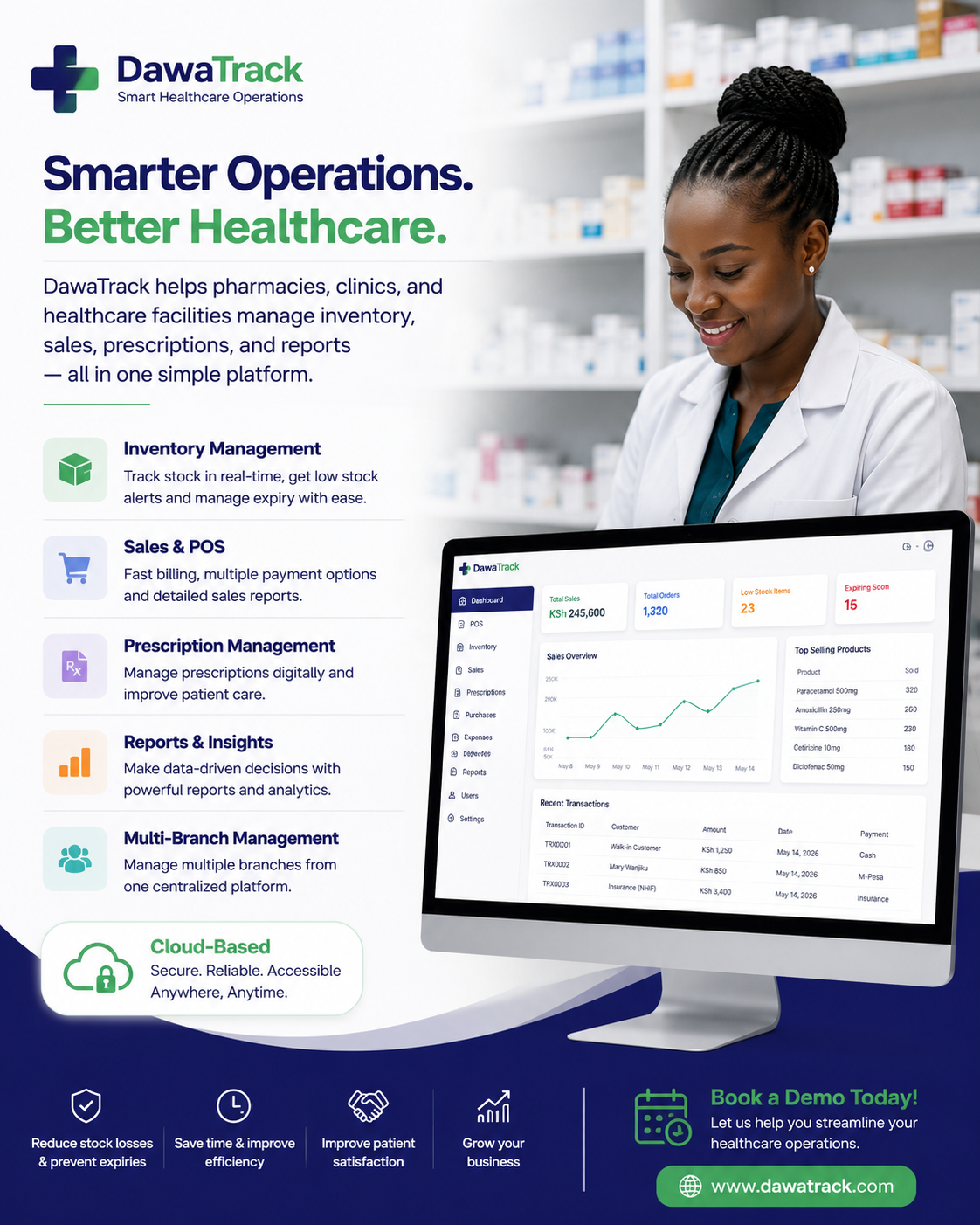
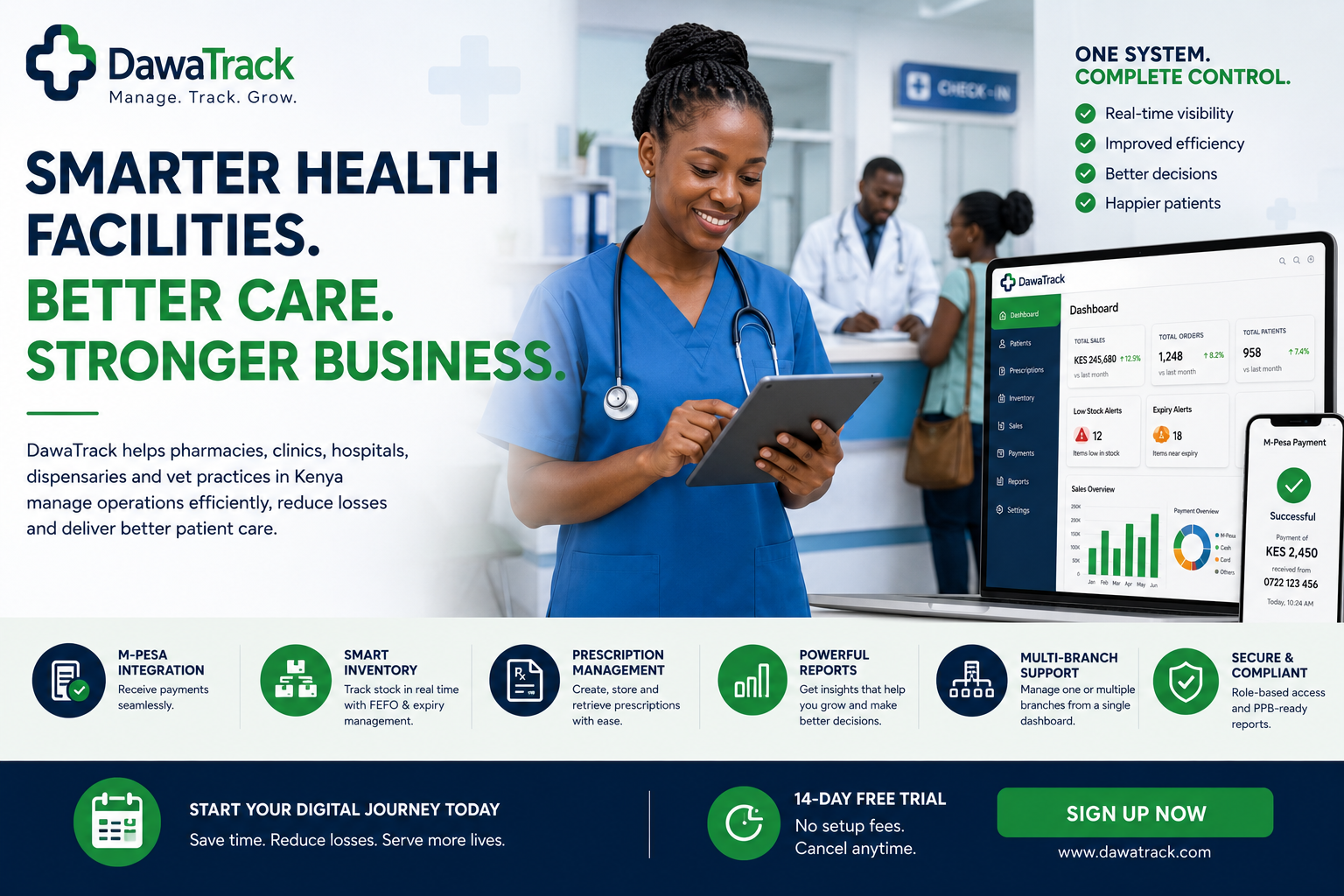
DawaTrack helps pharmacies, clinics, hospitals, dispensaries, and veterinary practices manage operations from one centralized cloud platform.
Features include:
-
M-Pesa integration
-
Real-time inventory tracking
-
FEFO expiry management
-
Prescription management
-
Multi-branch support
-
Analytics and reporting
-
Role-based staff permissions
With plans starting from KES 999/month and a 14-day free trial, facilities can start digitizing operations without heavy upfront costs.
Healthcare is becoming more digital every year. The question is no longer whether facilities should modernize — but how soon they can afford to.